
A plain-English guide to the travel affiliate business model — how traffic turns into commissions, which partners pay, and what you actually need to launch one in 2026.
💡 The Quick Answer
A travel affiliate website earns money by referring visitors to third-party providers — hotels, flights, tours, insurance, eSIMs, car rentals — and collecting a commission when those visitors buy. The site itself doesn’t process the booking, sell tickets, or hold inventory. It’s a content-and-referral business, not a travel agency.
If you’ve ever wondered how do travel affiliate websites make money without owning a single hotel room or airline seat, this guide walks you through the entire model — the traffic, the partners, the commission triggers, and the seven main revenue streams travel affiliates typically stack in 2026. By the end you’ll know what makes this business tick and what it realistically takes to build one.
What Is a Travel Affiliate Website?
A travel affiliate website is a content site that helps travelers make decisions — where to stay, which flight to book, what to do at a destination — and refers them to booking partners via tracked affiliate links. When a visitor clicks that link and completes a booking on the partner’s website, the partner pays the affiliate a commission.
The site never sees the traveler’s credit card, never issues the ticket, and never handles customer service. Its job is simple: attract the right traveler, publish useful content, and hand off the transaction to a trusted brand like Booking.com, Agoda, Skyscanner, or GetYourGuide. For a deeper primer on the format, see this breakdown of how a travel affiliate website is structured.
Think of it as digital travel real estate. You build a well-optimized page on “Best hotels in Lisbon for couples,” a traveler lands there from Google, reads your recommendation, clicks through to Booking.com, books a three-night stay — and you get a slice of that booking. Multiply that by hundreds of pages and thousands of visitors a month and you have a business.
How the Travel Affiliate Business Model Works
The mechanics are the same whether your site is tiny or has a million visitors a month. Every dollar earned flows through the same six-step pipeline:
Traffic comes mainly from Google search, YouTube, Pinterest, or email. Content answers the traveler’s question. The affiliate click is a tracked link — the tracking cookie is what tells the partner “this visitor came from you.” The travel partner handles the booking flow. If the transaction completes (and often only after the guest actually checks in or the trip is taken), a commission is paid out.
A few nuances worth knowing upfront: commissions can be revoked if the traveler cancels, cookies expire (typical windows are 30 to 365 days), and last-click attribution is standard — meaning if your visitor clicks a competitor’s link after yours, the competitor may get the payout. This is why cookie length matters when picking programs.
7 Ways Travel Affiliate Websites Can Monetize Traffic
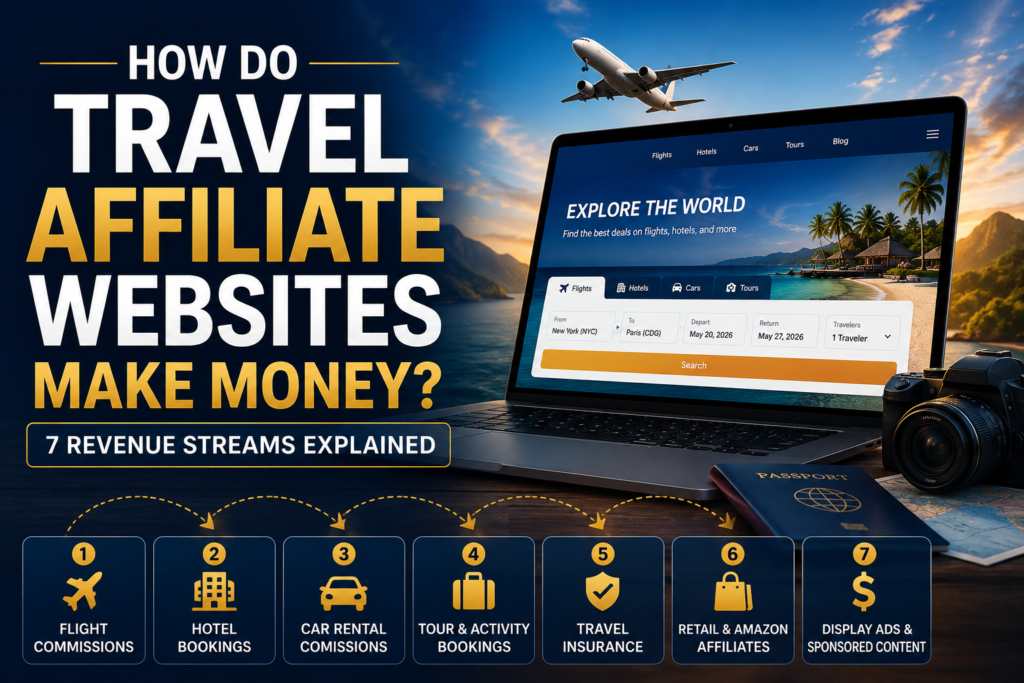
Successful travel affiliates rarely rely on a single partner. They stack multiple revenue streams because a single traveler often needs a flight and a hotel and an eSIM and insurance. Here are the seven categories that generate the bulk of travel affiliate revenue in 2026:
1. Hotel Affiliate Programs
The bread and butter. Booking.com, Agoda, Expedia, and Hotels.com typically pay 4–8% of the booking value. High volume, well-understood buyer intent.
Commission: 4–8%2. Flight Affiliate Programs
Lower per-ticket rates (~1–2%) but bookings are big-ticket. Skyscanner, Kiwi, and Aviasales (via Travelpayouts) dominate.
Commission: 1–2%3. Tours & Activities
GetYourGuide, Viator, and Klook pay 6–10% on experiences. Excellent for destination-specific “things to do in…” content.
Commission: 6–10%4. Car Rental Affiliates
Rentalcars, DiscoverCars, and Sixt pay 3–8% per rental. Rides road-trip and airport-transfer search intent.
Commission: 3–8%5. Travel Insurance
SafetyWing, World Nomads, and Heymondo pay 10–25%. High EPCs because policy prices are meaningful and buyers convert fast when worried.
Commission: 10–25%6. eSIM & Connectivity
Airalo, Saily, and Holafly are the breakout category of 2025–2026. Digital delivery, no shipping, high margins, commissions 10–20%.
Commission: 10–20%7. Travel Products & Accessories
Amazon Associates for luggage, packing cubes, portable chargers, and travel gear. Lower rates (1–4%) but 24-hour cookie captures anything the visitor buys.
Commission: 1–4%Most established sites run at least four of these simultaneously. For a curated list of programs to apply to, browse this directory of travel affiliate programs — it covers the payout terms, cookie windows, and approval difficulty of the major players.
Example of the Affiliate Journey: A Bali Traveler
Theory is easier when you follow one visitor end-to-end. Let’s trace a real-world scenario:
Multiply that by 40 similar travelers per month across your site and you’re at roughly $2,700/month. That’s the arithmetic of a well-built travel affiliate site.
How Much Can a Travel Affiliate Website Make?
Here’s the honest answer nobody wants to hear: it depends. Anyone promising a fixed monthly number is selling a course, not reality. Realistic ranges look like this:
Ready to Launch Your Travel Website?
| Monthly Visitors | Realistic Monthly Revenue (Well-Optimized) | Stage |
|---|---|---|
| 0 – 1,000 | $0 – $50 | Sandbox / learning phase |
| 1,000 – 10,000 | $50 – $500 | Traction starting |
| 10,000 – 50,000 | $500 – $3,500 | Side-income territory |
| 50,000 – 200,000 | $3,500 – $15,000 | Full-time viable |
| 200,000+ | $15,000+ | Established business |
Actual results shift with search intent (commercial vs. informational), conversion rates, average booking value, geography (US and UK travelers spend more), seasonality, and — critically — partner commission terms. The same 10,000 visitors reading “Where to eat in Rome” earn a fraction of what “Best 5-star hotels in Rome” would generate, because intent is worlds apart.
For a more grounded look at income realities and what beginners typically overlook, this guide to affiliate marketing for travel beginners is worth reading before you commit a year of your life to the model.
What Type of Content Generates Commercial Intent?
Not all traffic is equal. A page titled “Fun facts about Bali” gets tourists reading in bed. A page titled “Best hotels in Bali for couples” gets tourists reaching for their wallet. High-commercial-intent titles typically include buyer-mode keywords: best, top, where to stay, cheapest, review, vs.
The consistently high-converting patterns look like this:
- Best hotels in Bali — hotel commissions
- Where to stay in Rome — neighborhood + hotel commissions
- Best travel insurance for Europe — insurance commissions (high payout)
- Things to do in Dubai — tours & activities commissions
- Best eSIM for Japan — eSIM commissions
- Cheapest car rentals in Iceland — car rental commissions
- Ryanair vs EasyJet: which is better? — flight & downstream hotel clicks
If you’re still hunting for a direction, this list of travel affiliate niche ideas is a solid brainstorming input — narrow niches like luxury solo travel or family digital nomads convert much better than the generic “travel blog.”
SEO’s Role in the Business Model
SEO isn’t a nice-to-have — for most travel affiliates, it is the business. Paid ads on travel keywords are brutally expensive because they compete with Booking.com and Expedia’s own bids. Social traffic is fickle. Email works but requires a list. That leaves organic search as the highest-margin, most sustainable channel.
Effective travel SEO combines destination-level keyword research, cluster-based content architecture (a pillar page on “Bali travel” surrounded by 40 related articles), fast page speeds (Core Web Vitals matter), and internal linking that tells Google which pages are most important. E-E-A-T signals — author bios, first-hand travel photos, dates of visit — increasingly separate ranking sites from stuck ones.
Travel Blog vs Travel Affiliate Website
They sound identical. They’re not.
| Aspect | Travel Blog | Travel Affiliate Website |
|---|---|---|
| Primary content | Personal stories, itineraries, photography | Comparison content, booking-intent listicles |
| Traffic goal | Audience & community | Commercial search rankings |
| Monetization | Sponsorships, ads, occasional affiliate | Structured affiliate stack (7+ revenue streams) |
| Tone | First-person, narrative | Editorial + advisory |
| Ownership required | Author’s personal experiences | Systematic content production |
| Scale | Bottlenecked by author | Can scale with writers and tools |
Plenty of successful sites blend both — a strong founder story with a heavy affiliate engine underneath. If you want a deeper side-by-side, this travel affiliate website vs travel blog comparison breaks down which path fits which personality.
What You Need to Start
The build stack is refreshingly simple in 2026:
The domain should be brandable and topically relevant. WordPress + reliable hosting remains the dominant stack — flexible, SEO-friendly, and endlessly extensible. Your website needs a theme built for travel (search widgets, comparison tables, destination archetypes). Affiliate partner approvals typically come from networks like Travelpayouts, Awin, CJ, or direct programs. Content is where 80% of your time goes. Traffic follows from consistent SEO. And tracking — Google Analytics, Search Console, plus affiliate dashboards — tells you what’s actually working.
If picking hosting feels overwhelming, this roundup of the best travel tools for affiliate marketers covers hosting, plugins, and tracking utilities most pros use.
Building It Manually vs Using a Pre-Built Solution
You have two realistic paths:
Path A — Build It Manually
- Total creative control over design and features
- Deep learning of WordPress, SEO, and integrations
- Very low upfront cost (hosting + domain)
- 3–6 months typical setup time for a competent build
- Ongoing responsibility for updates, security, API breakage
Path B — Use a Pre-Built Platform
- Launch in hours instead of months
- Hotel/flight/car search engines already integrated
- Multiple affiliate partners pre-wired (Agoda, Aviasales, Travelpayouts)
- Higher upfront cost, but usually a one-time payment
- Less low-level customization freedom
Path A suits developers, tinkerers, and people who genuinely enjoy the build. Path B suits creators, marketers, and side-hustlers who want to skip the plumbing and get to content and traffic — the parts that actually generate revenue.
This is where a platform like Travel Affiliate Guru V4 fits. It’s a WordPress-based, one-time-payment travel affiliate system that ships with a 1.3M+ hotel search, a 728-airline flight search, a car rental module, cruise bookings, eSIM data, travel insurance, plus AI article writer and AI trip planner tools — all pre-integrated with Agoda, Booking, Skyscanner, Aviasales, and Travelpayouts. No coding, no monthly subscription, and the first website installation is done for you.
Full technical breakdown lives on the Travel Affiliate Guru V4 features page, and if you want to compare the DIY route against a done-for-you build, the how-to guide on building a travel affiliate website covers both angles honestly.
“I launched my travel website in under an hour. Setup was simple and I had flights and hotels working right away. Two months in, I’m seeing my first Agoda commissions come through — and I never touched a line of code.”
— Marcus K., Travel Blogger, Germany · 2026Final Take
Travel affiliate websites make money by owning search-intent real estate and routing intent to trusted booking partners. It’s not passive, it’s not overnight — but the model is proven, the tools have never been cheaper, and the 2026 launch stack (WordPress + a done-for-you platform + AI content help) removes 90% of the historical friction. If you enjoy writing about travel and are willing to compound content monthly, this is one of the more durable niches in affiliate marketing.
Ready to Build Your Travel Affiliate Website?
Explore Travel Affiliate Guru V4 and see how the platform is designed to help you build a professional travel affiliate website — with hotel search, flight search, car rentals, eSIMs, insurance, and AI content tools all pre-integrated. One-time payment. Free first setup included.
🚀 Explore Travel Affiliate Guru V4