

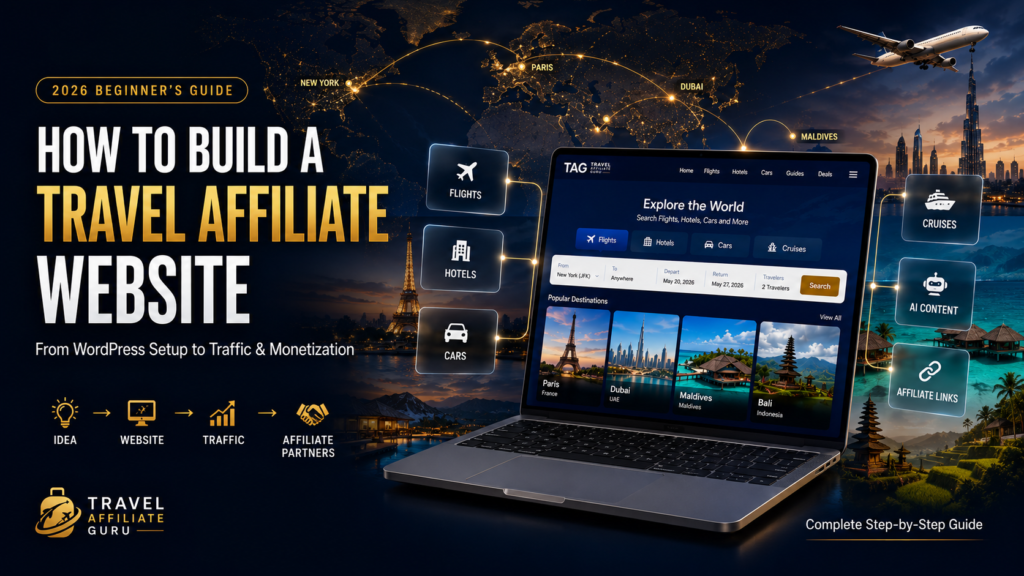
A step-by-step, plain-English guide to building a travel affiliate website that turns curious travelers into referral commissions through content, search tools, and trusted partner programs.
Millions of travelers plan every trip online. They research destinations, compare hotels, hunt for cheap flights, and read countless reviews before they book anything. That massive search demand is exactly what a travel affiliate website is built to serve — and why how to build a travel affiliate website has become one of the most searched beginner questions in affiliate marketing this year.
This article explains the full beginner journey: the business model, planning choices, partner selection, SEO, promotion, and common mistakes. If you are ready to implement the technical setup step by step, use our travel affiliate website setup checklist for domain, hosting, WordPress, and launch decisions.
A well-built travel site can guide visitors to helpful information, then earn a commission when they book with a trusted partner. In this complete 2026 guide, you’ll learn what a travel affiliate business really is, how it makes money, and every practical step to launch one — from picking a niche to installing WordPress, adding search tools, choosing affiliate programs, and driving traffic.
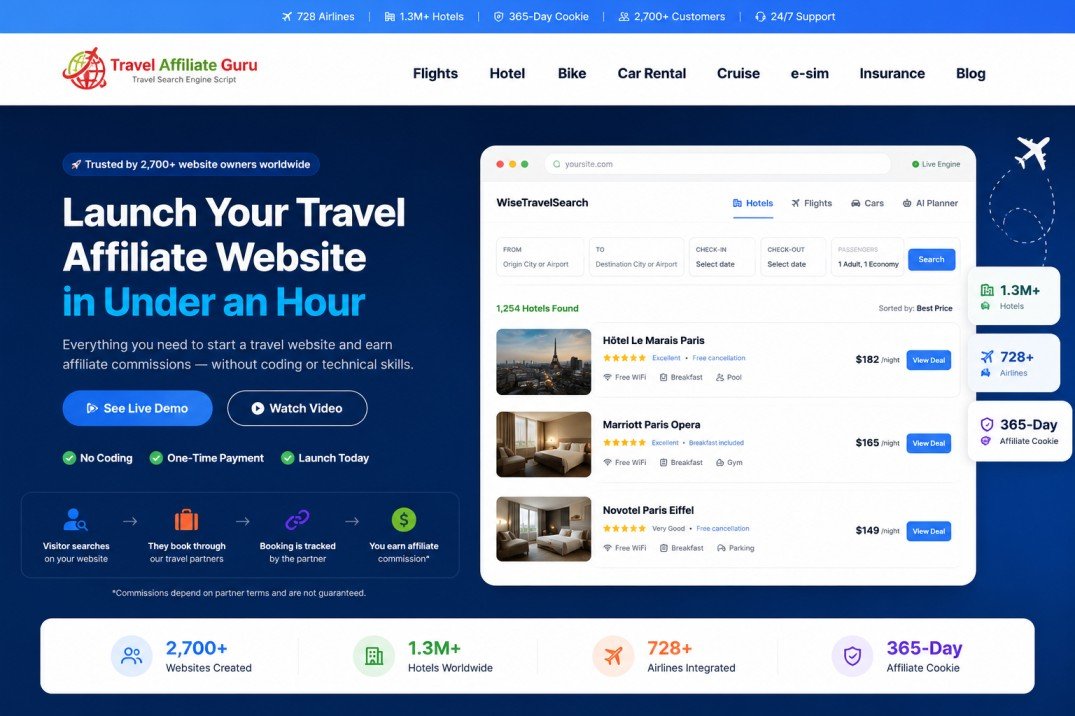
A modern travel affiliate website combines useful content with real-time hotel and flight search.
What Is a Travel Affiliate Website?
A travel affiliate website is a content-driven website that helps travelers plan trips, then refers them to third-party travel providers such as hotels, airlines, tour operators, or insurance companies. When a visitor completes an eligible action — usually a booking — the website owner may earn an affiliate commission based on that partner’s terms.
The website itself does not usually process the booking. It acts as a helpful middle layer between the traveler and the provider.
A simple example
- A traveler searches Google for “best boutique hotels in Lisbon”.
- They land on your travel affiliate website.
- They read your guide, then use your embedded hotel search or click an affiliate link.
- They’re taken to a partner like Booking.com or Agoda.
- They complete their reservation on the partner’s site.
- The partner attributes the booking to you and pays a commission according to their terms.
Travel Blog vs Travel Affiliate Website: What’s the Difference?
People often confuse a travel blog with a travel affiliate website. They overlap, but they aren’t the same thing.
📝 Travel Blog
- Primarily content-focused
- Personal stories, itineraries, photos
- Monetization often includes ads and sponsored posts
- Affiliate links may appear but aren’t the primary focus
🏨 Travel Affiliate Website
- Combines content with search & discovery tools
- Purpose-built to drive commercial travel actions
- Monetization is affiliate-first
- Often includes hotel/flight/car search integrations
The two models can also be combined. Many successful publishers start as travel bloggers, then add affiliate search tools once they know their audience. If you’re brand new to this world, our affiliate marketing for travel beginners guide is a great next read.
How Does a Travel Affiliate Website Make Money?
Travel is one of the largest categories in affiliate marketing. According to Influencer Marketing Hub, travel and leisure make up roughly 16% of global affiliate revenue. Here are the main ways travel affiliate websites earn:
| Category | Example Partners | Typical Commission Structure* |
|---|---|---|
| Hotels | Booking.com, Agoda, Expedia | Per-booking commission or CPA |
| Flights | Skyscanner, Aviasales, Kiwi | Per-click or per-booking |
| Car Rentals | Rentalcars, DiscoverCars | Per-booking commission |
| Cruises | CruiseDirect, Vacations To Go | Per confirmed booking |
| Tours & Activities | Viator, GetYourGuide, Klook | Percentage of booking |
| Travel Insurance | SafetyWing, World Nomads | Fixed or percentage-based |
| eSIM / Mobile Data | Airalo, Holafly | Per plan sold |
*Commission structures, attribution periods, and eligibility vary by program. Always check the current terms.
For a deep-dive comparison of specific programs, see our full travel affiliate programs guide.
Step 1 — Choose Your Travel Niche
1Pick a defined audience, not “everyone who travels.”
A specific niche makes SEO easier, branding sharper, and content more focused. It also helps you compete against giant travel sites that cover everything shallowly.
For more inspiration, check our full list of travel niche ideas.
Step 2 — Choose Your Domain and Brand
2Your domain is your identity. Choose carefully.
- Keep it short — under 15 characters if possible.
- Make it memorable — easy to say out loud.
- Easy spelling — no weird hyphens or numbers.
- Avoid trademarks — never use “Booking”, “Airbnb”, “TripAdvisor”, etc.
- Think long term — don’t box yourself into one city if you plan to expand.
A .com extension still carries the most authority for travel businesses in most markets.
Step 3 — Get Hosting and Install WordPress
3WordPress powers roughly 43% of the web — including most successful affiliate sites.
Why choose WordPress for a travel affiliate WordPress website?
- Ownership — you own your content, unlike hosted platforms.
- SEO — extensive control over titles, schema, permalinks.
- Content management — publish long guides easily.
- Plugins — thousands of tools for search, forms, caching, security.
- Customization — themes, layouts, and code are all editable.
- Scalability — grows from side project to full business.
Choose a reliable hosting provider with good speed, SSL, and daily backups. See our recommended web hosting options for travel sites.
Step 4 — Build the Travel Website
4This is where most beginners get stuck.
Building a travel affiliate website manually involves stitching together several moving parts:
| Component | What It Does |
|---|---|
| Theme | Controls the site’s visual design |
| Page Builder | Elementor, Divi, or similar to design pages |
| Travel Integrations | Hotel, flight, car rental data |
| Affiliate Links | Deep-linking with your unique IDs |
| Search Functionality | Forms that pull real-time pricing |
| API Configuration | Connecting Booking.com, Skyscanner, etc. |
| Content System | Blog structure, categories, tags |
| SEO | Schema, sitemaps, meta data |
| Analytics | Tracking every visit and click |
Assembling these separately requires significant time and configuration, especially if you’ve never worked with APIs before. This is exactly why platforms like Travel Affiliate Guru exist — we’ll get to that later.
Step 5 — Choose Travel Affiliate Partners
5Not all travel affiliate programs are created equal.
You can join affiliate networks (which aggregate many brands) or individual programs directly. Common categories include:
- Flights (Skyscanner, Aviasales, WayAway)
- Hotels (Booking.com, Agoda, Hotels.com)
- Car rentals (Rentalcars, DiscoverCars)
- Cruises (CruiseDirect)
- Tours (Viator, GetYourGuide, Klook)
- Insurance (SafetyWing, World Nomads)
- eSIM (Airalo, Holafly)
Compare programs on these seven factors:
- Commission structure — flat fee vs percentage
- Cookie / attribution period — 24 hours to 365 days
- Geographic coverage — global vs regional
- Approval requirements — some programs need site traffic thresholds
- Payment methods — PayPal, wire, check
- Integration options — widgets, deep links, APIs, XML feeds
- Terms and conditions — read them carefully
Step 6 — Add Travel Search and Discovery Tools
6Search tools turn passive readers into active bookers.
Instead of just linking out with text, embed real search widgets so visitors can:
- Search flights between airports
- Compare 1.3M+ hotels by dates and location
- Browse destinations visually
- Find car rentals for a specific city
- Explore cruise itineraries
Depending on the integration, visitors may see live pricing on your site and then complete their booking on the third-party provider’s platform. You can see this in action on the Wise Travel Search v4 demo.
Step 7 — Create Useful Travel Content
7Content is still king — especially in Google’s helpful-content era.
Focus on genuinely useful content that answers real traveler questions:
- Destination guides (“Complete guide to visiting Kyoto”)
- Where to stay (“Best neighborhoods in Lisbon for first-time visitors”)
- Things to do (“21 unique things to do in Marrakech”)
- Travel itineraries (“7-day Iceland ring road itinerary”)
- Hotel comparisons (“Ritz vs Four Seasons Bali”)
- Travel tips (“How to survive a 14-hour layover”)
- Best time to visit (“When to visit Bali for perfect weather”)
- Transportation guides (“Getting from Rome airport to city center”)
- Budget guides (“Tokyo on $60/day”)
Step 8 — Build an SEO Strategy
8SEO is where most of your free traffic will come from.
A solid SEO foundation for a travel booking website includes:
Ready to Launch Your Travel Website?
- Keyword research — use tools like Ahrefs, Semrush, or free Google Keyword Planner
- Search intent — match your content to what searchers actually want
- Topic clusters — group related content around a pillar page
- Internal linking — connect related articles logically
- On-page SEO — titles, headings, meta descriptions
- Schema markup — Article, FAQ, Review, HowTo where relevant
- Site speed — under 3 seconds mobile load time
- Mobile usability — Google indexes mobile first
- Helpful, original content — no AI spam
Example topic cluster: “Bali Travel”
Cluster pages:
- Best time to visit Bali
- Where to stay in Bali (Ubud vs Seminyak vs Canggu)
- Best resorts in Bali under $200/night
- 7-day Bali itinerary
- Bali airport transfer guide
- Bali visa requirements 2026
- Bali eSIM comparison
Step 9 — Promote the Website
9Google isn’t the only traffic source. Diversify from day one.
- Google SEO — long-term compounding traffic
- Pinterest — huge for travel discovery, especially in the U.S. and Europe
- YouTube — vlogs, destination walkthroughs, tips
- Instagram — visual storytelling and reels
- Facebook — travel groups and community engagement
- Email marketing — you own this list, no algorithm risk
- Relevant communities — Reddit, forums, Discord servers
Step 10 — Track Performance
10What gets measured gets improved.
Set up these tools from day one:
- Google Analytics 4 — visitor behavior
- Google Search Console — search performance
- Affiliate dashboards — clicks, conversions, commissions
Metrics that matter:
| Metric | What It Tells You |
|---|---|
| Visitors | Overall traffic health |
| Search impressions | Google visibility |
| CTR (Click-Through Rate) | How well titles perform |
| Affiliate link clicks | Which content drives commercial action |
| Conversion rate | % of clicks that become bookings |
| Top content | Which pages to double down on |
| Traffic sources | Where visitors come from |
The Difficult Part: Building Everything From Scratch
You can absolutely build a travel affiliate website manually. Thousands of people do. But it’s worth being honest about what “manually” involves:
👍 What DIY Gives You
- Total creative control
- Lower upfront cash cost
- You learn every layer of the stack
- Fully custom brand
👎 What DIY Costs You
- Weeks to months of setup time
- Steep learning curve on APIs and integrations
- Ongoing plugin conflicts and updates
- Debugging search widgets and payment tracking
- Slow launch = delayed content creation
According to industry surveys, hiring a developer to build a custom travel affiliate site typically costs $3,000+ and takes months. For non-technical creators, this is often the biggest bottleneck.
A Faster Alternative — Travel Affiliate Guru
Travel Affiliate Guru is a WordPress-based solution designed specifically for building travel affiliate websites. Instead of assembling every component independently, you get a pre-built foundation you can customize and launch quickly.
What’s typically included:
- Travel-focused WordPress website
- Flight search (728+ airlines)
- Hotel search (1.3M+ properties)
- Car rental options
- Cruise browsing
- AI-assisted content tools (trip planner and article writer)
- Homepage building and customization
- Affiliate integration for Agoda, Booking.com, Skyscanner, TravelPayouts, Expedia, and more
- SEO-friendly structure
- Responsive mobile design
- White-label branding where supported
- Travel Affiliate Guru is not a travel agency and does not process travel bookings.
- Travel searches and bookings involve integrated third-party travel and affiliate partners under their own terms.
- Commissions, traffic, rankings, and earnings are never guaranteed — they depend on your effort, content, and partner terms.
The value isn’t magic — it’s time saved. You skip the API-configuration nightmare and can focus on what actually drives revenue: content and traffic.
A popular walkthrough showing the general approach to building an automated travel affiliate site.
Who Is Travel Affiliate Guru For?
✅ Great fit
- Travel bloggers wanting to monetize
- Affiliate marketers entering travel
- SEO professionals targeting travel keywords
- Content creators (YouTube, IG, Pinterest)
✅ Also a fit
- Solo entrepreneurs & side-hustlers
- Digital agencies serving travel clients
- Existing travel publishers upgrading their tech stack
- People who want to skip API configuration
How Much Does It Cost to Start a Travel Affiliate Website?
Costs vary based on your setup, but here are the typical categories:
| Category | Typical Range | Notes |
|---|---|---|
| Domain | $10 – $20/year | .com preferred |
| Hosting | $5 – $30/month | Shared to managed WordPress |
| WordPress software | Free | Open source |
| Theme/plugins | $0 – $500+ | Depends on stack |
| Development (if hired) | $500 – $5,000+ | Skip if using a platform |
| Content (writers/AI) | Variable | Biggest ongoing cost |
| Marketing tools | $0 – $200/month | SEO, email, analytics |
Using a pre-built platform can reduce or eliminate the development category. Everything else stays roughly the same.
Common Mistakes to Avoid
🚫 Beginner Mistakes
- Choosing an overly broad niche (“travel”)
- Publishing thin, low-value AI content
- Ignoring SEO fundamentals
- Joining too many affiliate programs at once
- Poor mobile experience
- Slow website (over 4-second load time)
- Overloading pages with affiliate links
- Not disclosing affiliate relationships (illegal in many places)
- Expecting instant passive income
- Not measuring what works
✅ Do These Instead
- Pick a specific niche you can dominate
- Write for humans first, always
- Learn on-page SEO basics
- Start with 2–3 programs, master them
- Test mobile before every launch
- Optimize images and use caching
- Use links naturally in useful content
- Add a clear affiliate disclosure
- Plan for a 6–18 month growth curve
- Review analytics monthly
Can a Travel Affiliate Website Become a Real Business?
Yes — but it depends on realistic effort and expectations.
A travel affiliate website can grow into a real business generating meaningful monthly revenue. Success depends on:
- Traffic volume and quality
- Audience trust
- Content depth and originality
- Search visibility over time
- Marketing consistency
- Partner terms and commission structures
- Conversion performance
It is not instant passive income. Most successful travel affiliate sites take 6–18 months of consistent work before they generate meaningful revenue. Some take longer. Some never do. That’s the honest reality — and it’s why most people quit before they succeed.
Frequently Asked Questions
What is a travel affiliate website?
A travel affiliate website helps travelers plan trips through content and search tools, then refers them to third-party travel providers. When a visitor completes an eligible booking, the site owner may earn a commission based on the partner’s terms.
Do I need coding knowledge to build one?
No. Modern WordPress and pre-built platforms like Travel Affiliate Guru allow non-technical creators to launch a working site without code. Custom design will require some technical familiarity or a developer.
Can I build a travel affiliate website with WordPress?
Yes. WordPress is the most popular content management system for travel affiliate sites because of its flexibility, SEO capabilities, and extensive plugin ecosystem.
How do travel affiliate websites make money?
They earn commissions when visitors book with partners like Booking.com, Agoda, Skyscanner, Viator, and others. Commission structures, attribution windows, and eligibility vary by program.
Do I need to be a travel agent?
No. A travel affiliate website is not a travel agency. You are not processing bookings, holding funds, or acting as an agent. You refer travelers to licensed providers who handle those transactions.
Can I add hotel and flight search to WordPress?
Yes. You can use plugins, embedded widgets, or full solutions like Travel Affiliate Guru to add real-time hotel, flight, car, and cruise search to your WordPress site.
How long does it take to build a travel affiliate website?
Anywhere from a few hours (with a pre-built platform) to several months (custom development). Generating meaningful revenue typically takes 6–18 months of consistent content and SEO work.
Do I need travel APIs?
Only if you want live pricing and inventory. Many affiliates start with simple deep links and add search widgets or APIs later once they understand which content converts.
What is Travel Affiliate Guru?
Travel Affiliate Guru is a WordPress-based solution designed for building travel affiliate websites. It provides a pre-built foundation with integrated hotel, flight, car, and cruise search, plus AI content tools and affiliate integration — reducing the technical setup work required.
Can beginners start travel affiliate marketing?
Absolutely. Travel affiliate marketing is one of the most beginner-friendly niches because of its large audience, high search volume, and abundance of programs. See our beginner’s guide for a full walkthrough.
Ready to Build Your Travel Affiliate Website?
Travel is one of the largest and most search-heavy niches on the internet. Millions of people research trips online every single day, and a well-built travel affiliate website can turn a slice of that demand into a real business.
You have two paths:
- Build everything yourself — full control, longer timeline, steeper learning curve.
- Use a pre-built solution — skip the technical setup and focus on content and traffic from day one.
Either way, the fundamentals stay the same: pick a niche, publish helpful content, join relevant affiliate programs, and be patient with SEO.
If you want to skip the technical foundation and get straight to creating content, Travel Affiliate Guru is a WordPress-based platform designed specifically for this. It includes hotel, flight, car, and cruise search, AI content tools, and affiliate integration — all pre-configured. There’s also a live demo you can explore before deciding.
Disclosure: This article contains affiliate links. If you use them to make a purchase, we may earn a commission at no extra cost to you. Affiliate earnings are never guaranteed and depend on many factors including traffic, content quality, and partner terms.