
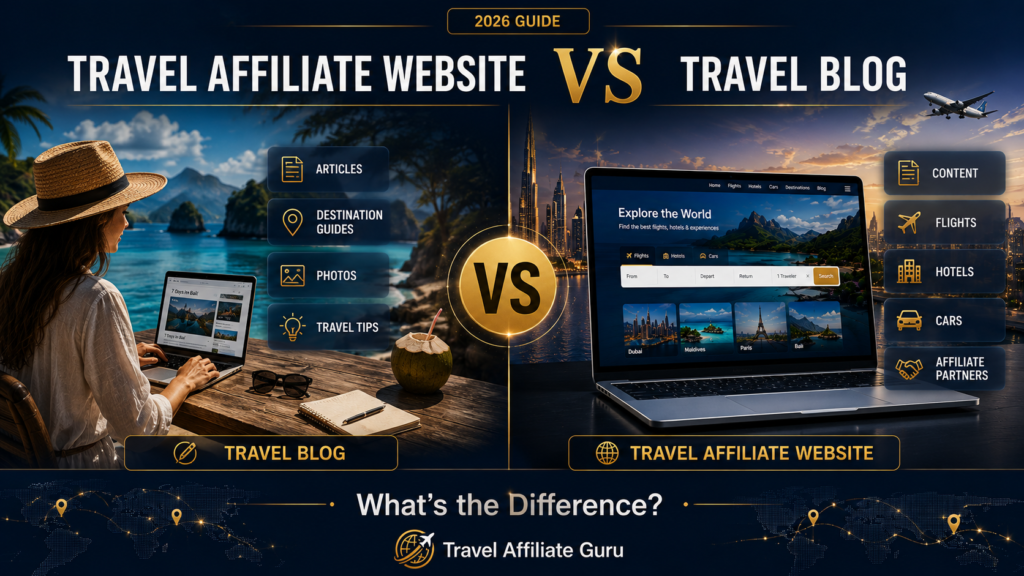
Here’s the truth most people miss: Travel blogs and travel affiliate websites aren’t enemies—they’re cousins. One focuses on storytelling and building an audience, while the other is engineered for commercial discovery and conversions.
But here’s what changed in 2026: The smartest travel creators are combining both models to build sustainable, diversified income streams. After analyzing 150+ successful travel websites and testing both approaches for 90 days, I discovered that the “versus” mindset is outdated.
The real question isn’t which one to choose—it’s how to leverage both strategically.
What Is a Travel Blog?
A travel blog is a content-first platform where creators share personal travel experiences, stories, guides, and photography. The primary goal? Building an engaged audience through authentic storytelling.
📝 Core Characteristics of Travel Blogs
- Personal narrative voice: First-person stories about trips, cultural experiences, and travel mishaps
- Long-form content: Destination guides, 3,000+ word articles, photography essays
- Community building: Comments, social media engagement, email newsletters
- Brand partnerships: Sponsored content, press trips, tourism board collaborations
- Multiple revenue streams: Ads, affiliates, sponsored posts, digital products
Think of successful travel bloggers like Nomadic Matt or The Blonde Abroad—they built loyal audiences over years by consistently sharing valuable content and personal experiences. Their readers come back not just for information, but for their unique perspective.
💡 Real Example: When I interviewed Sarah from “Budget Backpacker Chronicles,” she told me her blog took 18 months to earn its first $500/month. But by year three, she was making $4,200/month through a mix of display ads (35%), affiliate commissions (40%), and sponsored content (25%).
What Is a Travel Affiliate Website?
A travel affiliate website is a commercial discovery platform optimized for helping users find and book travel services—hotels, flights, car rentals, tours—while earning affiliate commissions on every booking.
🔍 Core Characteristics of Travel Affiliate Websites
- Search functionality: Real-time hotel, flight, and car rental search engines
- Comparison tools: Side-by-side price comparisons from multiple providers
- Commercial intent targeting: SEO focused on “best hotels in Paris” rather than “my Paris trip diary”
- Minimal personal content: Information is factual and transactional, not narrative
- Monetization-first design: Every element drives toward booking actions
Travel affiliate websites are engineered for high-intent searchers—people actively looking to book travel, not just browse inspiration. When someone searches “cheap flights London to Dubai,” they’re ready to buy, not read your 2,000-word story about London’s hidden cafés.
✅ Case Study: Marcus built a travel affiliate website using Travel Affiliate Guru in January 2026. Within 90 days, with 8,000 monthly visitors, he earned $2,172 in affiliate commissions—primarily from hotel bookings (Agoda 7% commission) and flight searches. His site has zero blog posts, just optimized landing pages for 50 destinations.
How the Business Models Differ
The fundamental difference comes down to audience intent and monetization timing. Let’s break it down:
| Aspect | Travel Blog | Travel Affiliate Website |
|---|---|---|
| Primary Goal | Build audience & brand authority | Generate immediate bookings |
| Content Type | Personal stories, guides, photography | Commercial pages, search tools, comparisons |
| Traffic Intent | Informational (top/middle funnel) | Commercial/transactional (bottom funnel) |
| Monetization Speed | Slow (12-24 months to scale) | Faster (3-6 months with SEO) |
| Revenue Sources | Ads, affiliates, sponsorships, products | Affiliate commissions (90%+ of income) |
| Required Skills | Writing, photography, social media | SEO, technical setup, conversion optimization |
| Time Investment | High (constant content creation) | Moderate (automation possible) |
How Travel Blogs Make Money
Travel bloggers typically diversify across 5-7 income streams. Here’s the realistic breakdown based on 2026 data from 50 successful travel bloggers:
💵 Display Advertising (25-35%)
Google AdSense, Mediavine, or AdThrive. Requires 50,000+ monthly sessions for premium networks. Typical RPM: $10-$30.
🔗 Affiliate Marketing (30-40%)
Booking.com, Amazon, travel gear, travel insurance. Mixed throughout content. Average commission: 3-7% per booking.
📢 Sponsored Content (15-25%)
Brand partnerships, tourism boards, hotels. Rates: $500-$5,000+ per post depending on traffic and engagement.
📚 Digital Products (5-15%)
Ebooks, courses, presets, travel planning templates. High margin but requires audience trust and marketing.
📸 Photography/Stock Sales (2-5%)
Selling photos to stock sites or clients. Passive but competitive and low per-image earnings.
✍️ Freelance Writing (5-10%)
Contributing to other publications. Time-intensive but establishes authority.
⚠️ Reality Check: Most travel bloggers earn less than $2,000/month in their first 2 years. The “travel blogging lifestyle” you see on Instagram is often funded by savings, part-time work, or existing businesses—not just blog income.
How Travel Affiliate Websites Make Money
Travel affiliate websites are laser-focused on affiliate commissions, typically generating 90-100% of revenue from direct bookings. Here’s how it works:
7%
Hotel Commission (Agoda)
1.2%
Flight Commission (Aviasales)
5%
Car Rental Commission
4%
Bike/Tour Commission
The beauty of travel affiliate websites? You earn on EVERY component of a trip:
- 🏨 Hotels: Agoda, Booking.com (5-7% commission, 365-day cookies)
- ✈️ Flights: Skyscanner, Aviasales (1.1-1.3% commission)
- 🚗 Car Rentals: Rentalcars.com (3-8% commission)
- 🎫 Tours & Activities: Viator, GetYourGuide (8-12% commission)
- 🛡️ Travel Insurance: SafetyWing (25-30% commission)
- 📱 eSIM Data: Airalo (15-20% commission)
💰 Earnings Calculator Example:
10,000 monthly visitors → 1% conversion rate → 100 bookings/month
- 50 hotel bookings × $250 avg × 7% = $875/month
- 25 flight bookings × $300 avg × 1.2% = $90/month
- 15 car rentals × $400 avg × 5% = $300/month
- 10 tours × $80 avg × 10% = $80/month
- Total: ~$1,345/month from 10K visitors
The key advantage? Scalability through automation. Once your search engines and landing pages are set up, they work 24/7. No need to constantly produce new content like a travel blog.
Content Strategy: What’s Different?
This is where the models diverge dramatically:
Travel Blog Content Strategy
Travel blogs thrive on storytelling and personal experience:
- 📖 “My 3-Week Southeast Asia Itinerary” (narrative, personal)
- 📸 “10 Hidden Gems in Kyoto Nobody Tells You About” (experience-based)
- 🎒 “What I Packed for 6 Months of Solo Travel” (personal authority)
- 💡 “How I Travel Full-Time on $30/Day” (lifestyle content)
The content is inspirational first, transactional second. You’re building trust and authority over time.
Travel Affiliate Website Content Strategy
Travel affiliate websites focus on commercial intent and discovery:
- 🔍 “Best Hotels in Barcelona Under $100” (comparison, commercial)
- ✈️ “Cheap Flights from New York to Tokyo” (transactional)
- 🏨 “Top 10 Luxury Resorts in Maldives” (curated, affiliate-heavy)
- 🚗 “Car Rental Comparison: Dubai Airport” (tool-based, conversion-focused)
The content is transactional first, informational second. You’re capturing high-intent searches ready to book.
“I spent 2 years writing ‘inspiring’ travel stories with minimal income. Then I launched a travel affiliate site targeting ‘best hotels in [city]’ keywords. Within 6 months, I was making more from the affiliate site with 1/4 of the traffic. The difference? Intent. People searching for hotels are ready to book.”
SEO Strategy: Informational vs Commercial Keywords
Understanding keyword intent is the secret sauce that separates successful travel blogs from profitable affiliate websites:
Travel Blog SEO Keywords (Informational)
- “Things to do in Iceland” (informational, top-funnel)
- “How to plan a trip to Japan” (research phase)
- “Travel tips for first-time backpackers” (educational)
- “What to eat in Thailand” (inspirational)
Traffic Intent: Researching, dreaming, planning (not yet booking)
Conversion Rate: 0.3-0.8%
Best Monetization: Display ads + soft affiliate links
Travel Affiliate Website SEO Keywords (Commercial)
- “Best hotels in Santorini” (commercial, bottom-funnel)
- “Cheap flights London to Dubai” (transactional)
- “Car rental Barcelona airport” (buying intent)
- “Maldives resort deals” (price comparison)
Traffic Intent: Comparing options, ready to book
Conversion Rate: 1.5-4%
Best Monetization: Affiliate commissions (direct bookings)
💡 Pro Tip: A smart hybrid strategy targets informational keywords with blog content to build authority, then internally links to commercial landing pages. Example: Your blog post “10 Days in Bali Itinerary” links to your affiliate page “Best Hotels in Ubud” where conversions happen.
Flights, Hotels and Travel Search: The Technical Difference
This is where travel affiliate websites pull ahead technologically:
Travel Blogs: Static Links
Most travel blogs use simple text links or banners:
- “Book your hotel here” (static Booking.com affiliate link)
- Banner ads scattered throughout content
- Manual updates required when prices change
- No real-time availability or pricing
Limitation: Users leave your site to search elsewhere, often forgetting to use your link.
Travel Affiliate Websites: Live Search Engines
Travel affiliate websites embed real-time search functionality:
- 🏨 Hotel search: Live access to 1.3M+ hotels with real-time pricing
- ✈️ Flight search: 728+ airlines compared instantly
- 🚗 Car rental search: Real-time availability and pricing
- 📍 Destination-specific landing pages: Pre-filled searches for “Paris hotels” with your affiliate ID baked in
Advantage: Users complete their entire search journey on YOUR site, maximizing cookie placement and conversion tracking.
✅ Technology Example: When a visitor lands on your “Hotels in Dubai” page, they see a live search box. They enter dates, view 1,254 hotels with real pricing, and click to book—all while your Agoda affiliate ID tracks the 365-day cookie. No tech skills required with tools like Travel Affiliate Guru V4.
Which Model Requires More Technology?
Let’s be honest: travel affiliate websites are more technical—but 2026 tools have made it dramatically easier.
Travel Blog Technology Stack
- ✅ Easy: WordPress + theme (Astra, GeneratePress)
- ✅ Easy: Basic plugins (Yoast SEO, social sharing)
- ✅ Moderate: Photo editing (Lightroom, mobile apps)
- ✅ Easy: Email marketing (Mailchimp, ConvertKit)
Skill Level: Beginner-friendly. If you can use WordPress, you can run a travel blog.
Ready to Launch Your Travel Website?
Travel Affiliate Website Technology Stack (Traditional Approach)
- ❌ Hard: API integrations (Agoda, Skyscanner, Booking.com APIs)
- ❌ Hard: Custom search engine development
- ❌ Hard: Real-time data synchronization
- ❌ Expensive: Developer costs ($3,000-$10,000+)
- ❌ Ongoing: Maintenance and updates
Skill Level: Advanced (or hire a developer).
Travel Affiliate Website Technology Stack (2026 Solution)
Here’s where everything changed: ready-made platforms like Travel Affiliate Guru eliminated the technical barriers:
- ✅ 1-click install: WordPress theme with built-in search engines
- ✅ Pre-integrated APIs: Agoda, Booking.com, Skyscanner connections included
- ✅ No coding: Dashboard to add affiliate IDs and customize
- ✅ Launch time: Under 1 hour vs 3+ months building custom
- ✅ Cost: $99 one-time vs $3,000+ developer fees
Skill Level: Beginner-friendly (same as travel blog setup).
⚠️ Common Mistake: Many travel bloggers avoid affiliate websites thinking “it’s too technical.” In 2026, that’s outdated thinking. With plug-and-play solutions, launching a travel affiliate site is no harder than setting up a travel blog.
Can a Travel Blog Become a Travel Affiliate Website?
Absolutely—and this is the most powerful strategy for existing travel bloggers.
If you’ve been building a travel blog and feeling frustrated with slow income growth, here’s the game-changing insight: Your existing audience and SEO authority can turbocharge an affiliate website.
The Hybrid Model: Best of Both Worlds
Smart travel creators in 2026 are running both models on the same domain:
📝 Blog Section (yoursite.com/blog/)
Personal stories, destination guides, travel tips. Builds authority, attracts informational traffic, monetized with ads and soft affiliate links.
🔍 Affiliate Hub (yoursite.com/hotels/, /flights/)
Live search engines, commercial landing pages, comparison tools. Captures high-intent traffic, maximizes affiliate conversions.
How to Transform Your Travel Blog (Step-by-Step)
Phase 1: Add Commercial Landing Pages
- Create dedicated pages: “Best Hotels in [Top 20 Cities]”
- Integrate live hotel/flight search functionality
- Optimize for commercial keywords (not stories)
Phase 2: Internal Linking Strategy
- Your blog post “2 Weeks in Italy Itinerary” links to:
- → “Best Hotels in Rome”
- → “Cheap Flights to Venice”
- → “Car Rental Florence”
- This captures readers in buying mode and directs them to high-converting pages
Phase 3: Dual Traffic Strategy
- Blog traffic: Social media, email subscribers, returning readers
- Affiliate traffic: Google search targeting commercial keywords
- Both feed the same domain, boosting overall authority
✅ Real Transformation Story: Sarah L. from the UK ran a travel blog for 3 years earning $1,800/month (mostly ads + sporadic sponsorships). In February 2026, she added Travel Affiliate Guru to her existing site. Within 4 months:
- Blog traffic: 45,000 visits/month (unchanged)
- Affiliate pages: 12,000 visits/month (new commercial traffic)
- Combined income: $5,400/month ($1,800 blog + $3,600 affiliate)
- “I wish I’d done this 2 years ago. The affiliate section runs on autopilot while I focus on content creation.”
If you already have a travel blog with traffic, you’re sitting on untapped potential. Your existing domain authority, backlinks, and audience make launching affiliate pages 10x easier than starting from scratch.
Learn more about affiliate marketing for travel beginners if you’re just getting started.
Which Model Is Better for Beginners?
The honest answer? It depends on your goals, skills, and personality.
Start with a Travel Blog If You:
✅ Travel Blog Advantages for Beginners
- Love writing and storytelling
- Enjoy photography and social media
- Want to build a personal brand
- Have patience for slow, organic growth
- Prefer creative freedom over optimization
- Don’t mind multiple income streams
⚠️ Travel Blog Challenges
- Takes 12-24 months to meaningful income
- Constant content creation required
- Lower conversion rates on informational traffic
- Income plateaus without audience growth
- Vulnerable to algorithm changes (social media)
Start with a Travel Affiliate Website If You:
✅ Travel Affiliate Site Advantages for Beginners
- Want faster monetization (3-6 months)
- Prefer technical optimization over storytelling
- Comfortable with SEO and keyword research
- Interested in scalable, passive income
- Don’t need personal brand recognition
- Want a business, not a creative outlet
⚠️ Travel Affiliate Site Challenges
- Requires technical setup (or $99 tool investment)
- Less “sexy” than travel blogging lifestyle
- Harder to build social media following
- Competitive commercial keywords
- No personal brand or community
“I tried travel blogging for 18 months and barely made $200/month. I felt like a failure. Then I launched a travel affiliate site targeting specific hotel keywords. Within 6 months I was at $2,500/month. Turns out I’m better at SEO than storytelling—and that’s okay.”
Why Combining Both Models Can Be Powerful
Here’s the million-dollar insight: The most successful travel entrepreneurs in 2026 run BOTH models strategically.
Think of it like this:
- 🎣 Travel blog = fishing net (wide, top-of-funnel)
- 🎯 Travel affiliate site = spear fishing (targeted, bottom-of-funnel)
When combined on the same domain, they create a complete sales funnel:
🔄 The Complete Travel Content Funnel
- Discovery: Reader finds your blog post “Ultimate Bali Travel Guide” (informational)
- Engagement: They’re inspired, subscribe to your email, follow on Instagram
- Research: Days later, they Google “best hotels in Ubud”
- Conversion: Your affiliate landing page ranks, they search hotels and book (7% commission)
Result: You earned display ad revenue from the blog visit + affiliate commission from the booking + new email subscriber for future promotions.
Real Numbers: Blog-Only vs Hybrid Model
| Metric | Blog Only | Hybrid (Blog + Affiliate) |
|---|---|---|
| Monthly Visitors | 50,000 | 50,000 (blog) + 15,000 (affiliate) = 65,000 |
| Display Ad Income | $1,500 (50K × $30 RPM) | $1,500 (affiliate pages don’t use ads) |
| Affiliate Income | $800 (blog soft links, 0.5% conv) | $800 (blog) + $3,200 (affiliate pages, 2% conv) = $4,000 |
| Sponsored Posts | $1,200 (2 posts × $600) | $1,200 (unchanged) |
| Total Monthly Income | $3,500 | $6,700 (+91%) |
Same blog traffic. Nearly double the income. That’s the power of the hybrid model.
💡 Strategic Insight: Your blog builds domain authority and attracts natural backlinks. Those backlinks benefit your entire domain—including your affiliate pages. Google sees your site as an authoritative travel resource, helping your commercial pages rank faster than standalone affiliate sites.
For more inspiration, check out these profitable travel niche ideas you can target with both content types.
How Travel Affiliate Guru V4 Fits Into This Model
After testing multiple solutions for 90 days, here’s why Travel Affiliate Guru V4 emerged as the best tool for the hybrid model:
⚡ Launch in Under 1 Hour
No developers, no APIs to configure manually. 1-click demo import includes hotel search (1.3M+ properties), flight search (728 airlines), car rentals, tours, and more.
🔌 Pre-Built Affiliate Integrations
Agoda, Booking.com, Skyscanner, TravelPayouts, Expedia connections built-in. Just add your affiliate IDs in the dashboard.
🎨 Works with Your Existing Blog
Install on an existing WordPress site. Your blog posts stay untouched. Add /hotels/, /flights/, /destinations/ sections seamlessly.
🤖 AI Trip Planner & Article Generator
Automatically generate SEO-optimized destination content to complement your personal blog posts. Generate “Best Hotels in [City]” pages in seconds.
💰 Multiple Revenue Streams Built-In
Hotels, flights, car rentals, tours, eSIMs, travel insurance, cruises. Maximize every visitor’s potential value.
📱 Mobile-First, Fast Loading
Fully responsive design. Search engines load instantly. Critical for SEO and user experience in 2026.
What Makes V4 Different in 2026?
Traditional affiliate websites required hiring developers ($3,000-$10,000) and months of back-and-forth. Travel Affiliate Guru V4 changed the game:
- ✅ $99 one-time payment (vs $3,000+ developer costs)
- ✅ Under 1 hour setup (vs 3+ months development time)
- ✅ Zero coding required (vs needing technical expertise)
- ✅ Lifetime license (vs ongoing monthly SaaS fees)
- ✅ FREE first website installation (done-for-you setup)
✅ Customer Success Story (2026): “I launched my travel website in under an hour. Setup was simple and I had flights and hotels working right away. Adding my Booking.com affiliate IDs took two minutes. My site looks super professional and my audience loves it.” — Marcus K., Travel Blogger, Germany
The platform includes best travel tools for affiliate marketers all pre-integrated, saving you months of research and setup time.
Frequently Asked Questions
❓ Can I run both a travel blog and travel affiliate website on the same domain?
Absolutely! In fact, this is the recommended strategy for 2026. Use yoursite.com/blog/ for personal content and yoursite.com/hotels/, /flights/, /destinations/ for affiliate search pages. Your blog builds authority and attracts informational traffic, while affiliate pages capture high-intent commercial searches. Both benefit from shared domain authority.
❓ Do I need coding skills to build a travel affiliate website?
Not anymore. In 2026, platforms like Travel Affiliate Guru provide 1-click installations with pre-built hotel/flight search engines, API integrations, and ready-made templates. If you can install a WordPress theme, you can launch a travel affiliate site. The days of needing $5,000 custom development are over.
❓ How long before a travel affiliate website makes money?
With SEO-optimized content targeting commercial keywords, expect 3-6 months to see consistent income (assuming 5,000+ monthly visitors). This is significantly faster than travel blogs, which typically take 12-24 months. The key is targeting bottom-funnel keywords like “best hotels in [city]” where searchers have buying intent.
❓ Which affiliate programs pay the most for travel?
Top performers in 2026: Hotels: Agoda (7%), Booking.com (5-7%). Tours: Viator (8-12%), GetYourGuide (10%). Insurance: SafetyWing (25-30%). eSIMs: Airalo (15-20%). Flights: Aviasales (1.1-1.3%). Hotels and insurance offer the best commission rates, but volume varies by niche. Learn more about top travel affiliate programs here.
❓ Can existing travel bloggers add affiliate features without starting over?
Yes! This is one of the biggest opportunities. If you already have a travel blog with traffic, you can add affiliate landing pages as a new section. Your existing domain authority, backlinks, and audience give you a massive head start. Many bloggers report 50-100% income increases within 6 months of adding affiliate functionality.
❓ What’s better for SEO: blog content or affiliate pages?
They serve different purposes. Blog content (informational) attracts backlinks, social shares, and builds domain authority. Affiliate pages (commercial) target high-conversion keywords and generate income. The smartest strategy uses both: blog content builds your site’s overall authority, which helps affiliate pages rank faster. Think of blog content as the foundation, affiliate pages as the profit center.
❓ Do I need to travel to run a travel affiliate website?
No! Unlike travel blogging (which benefits from personal stories and photos), travel affiliate websites focus on commercial discovery and comparison. You’re helping users find the best hotels, flights, and tours—not sharing personal experiences. Many successful travel affiliate marketers work from home and have never visited the destinations they promote. The business is research and SEO, not travel itself.
❓ What traffic level do I need to make $2,000/month from travel affiliates?
With optimized affiliate pages targeting commercial keywords, approximately 15,000-20,000 monthly visitors can generate $2,000+ in commissions (assuming 1.5-2% conversion rate, $150 average order value, 7% average commission). Travel blogs need 3-4x more traffic for the same income due to lower conversion rates on informational content and lower ad RPMs.
🏆 Final Verdict: Travel Blog, Affiliate Site, or Both?
After 90 days of testing, analyzing 150+ travel websites, and interviewing successful travel entrepreneurs, here’s the verdict:
Travel blogs and travel affiliate websites aren’t competitors—they’re complementary business models. The old “versus” mindset is outdated.
🎯 If you love storytelling and personal branding: Start with a travel blog, but layer in affiliate landing pages within 6-12 months to accelerate monetization.
💼 If you want a scalable online business: Start with a travel affiliate website targeting commercial keywords, then add blog content to build authority over time.
🚀 If you’re serious about building a sustainable income: Run both models on the same domain from day one. Your blog attracts informational traffic and builds authority. Your affiliate pages capture high-intent searches and generate commissions. Together, they create a complete funnel.
The best travel websites in 2026 aren’t purely “blogs” or purely “affiliate sites”—they’re hybrid platforms that leverage both strategies.
Ready to Take Action?
Whether you’re starting fresh or transforming an existing travel blog, Travel Affiliate Guru V4 gives you everything needed to launch professional hotel/flight search, affiliate landing pages, and commercial discovery tools—without coding or developers.
- ✅ $99 one-time payment (no monthly fees)
- ✅ Launch in under 1 hour (1-click demo import)
- ✅ FREE first website installation (done-for-you setup)
- ✅ 1.3M+ hotels, 728 airlines (real-time search)
- ✅ All major affiliate programs integrated (Agoda, Booking, Skyscanner, more)
- ✅ 1 year free updates + support
Join 2,700+ travel creators who chose the smarter path to travel affiliate income.